 Help
Help ND assessment – school aged children
This page provides information for neurodevelopmental (autism and/or ADHD) assessment and diagnosis for school aged children and young people living in Leeds.
Changes have been made (July 2026) to improve the support that children, young people and their families access. Updated referral information is below. The referral process, including MindMate Single Point of Access (SPA), is run by Northpoint (mental health charity).
In all cases, assessment may be for autism, ADHD, or both at the same time (combined or dual assessment), depending on the need.
More information about autism and ADHD can be found in the Understanding Neurodiversity section.
ND assessment referrals for school aged children/young people in Leeds
Neurodevelopmental assessments for autism and ADHD for school-aged children are provided through the Right to Choose pathway in Leeds, as standard. More information about Right to Choose is available below.
School aged children/young people can be referred for routine neurodevelopmental (autism/ADHD) assessment via this MindMate Single Point of Access (SPA) dedicated autism/ADHD assessment referral form.
If a child or young person requires complex emotional wellbeing or mental health support as well as a neurodevelopmental (autism/ADHD) assessment, please complete the emotional well being referral form. Include both the emotional wellbeing needs and why a neurodevelopmental assessment is needed as part of their support.
The process for a routine school aged autism/ADHD neurodevelopmental assessment referral is explained below.
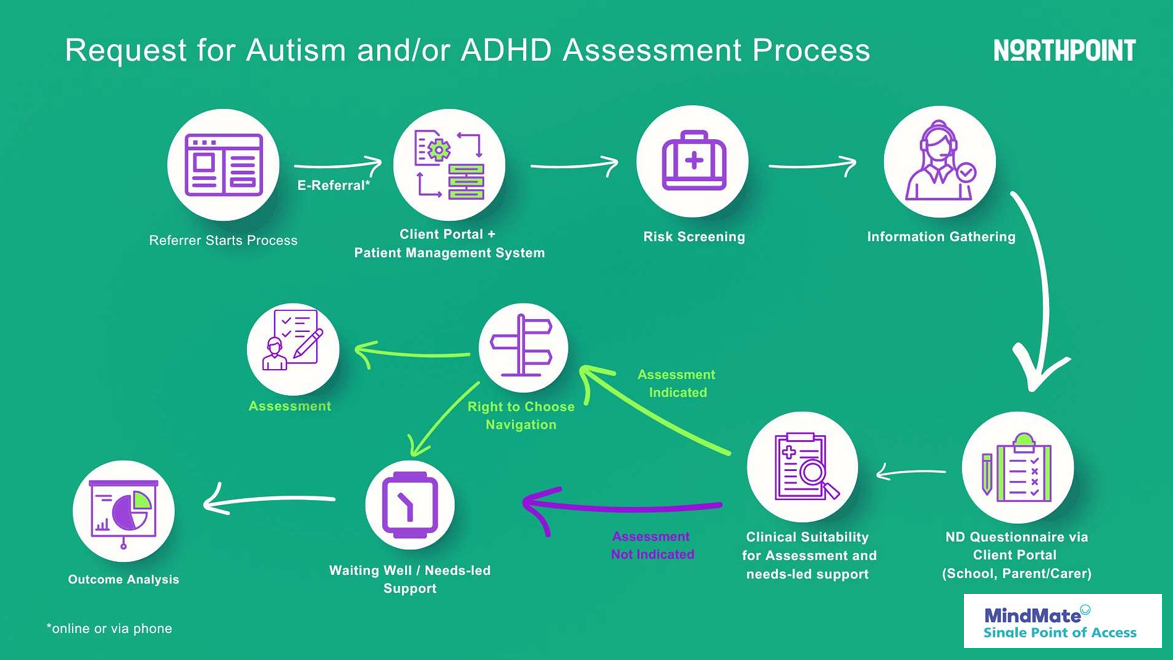
GPs, health and education practitioners, parents/carers and young people can refer for a school aged ND (autism/ADHD) assessment. It is helpful to discuss the referral with the child’s school, even if they did not make the referral. This is because the school are likely to be asked to complete a form about the child’s strengths, progress and support needs.
If you have questions about the referral, speak to your GP or phone the MindMate SPA team on 0300 555 0324 during office hours.
After the referral arrives, a clinician will review the information. They will check for any concerns about the child’s safety or wellbeing (risk screening). They will also consider if support from any other services may be helpful at this point, e.g. wider mental health support.
The team will also gather further information. Information will be gathered from parents, the child/young person (if appropriate) and a relevant professional (usually school). Questionnaires will be sent to collect information about the child’s strengths, progress and support needs. The questions will also focus on characteristics related to autism and ADHD.
When all the information is sent back, a clinician will look through it. The team will then contact the family to discuss the next best steps. This may include discussing a referral for an assessment. This may also include directing you to information to support the child/young person’s needs, without an assessment.
Waiting for assessment can take time and may feel uncertain. You can find lots of information and support on the ND Info Hub while you wait.
Assessments can be a little different at each service provider but a typical assessment process is described below. Your service provider will explain their assessment process when you’re invited to an appointment.
The assessment is all about gathering detailed information about your child, their development as they’ve grown up, their strengths, progress and challenges. The clinical standards for school aged autism and ADHD assessments in Leeds can be seen here.
The assessment focuses on your child’s individual needs and circumstances. Individually tailored recommendations will be made based on the individual circumstances of your child, whether a formal diagnosis is given or not.
- The child/young person having the assessment will be asked if they agree to having the assessment, where appropriate. This is called giving consent for the assessment. You and your family can change your mind at any time during the process.
- Parents/carers will be asked detailed questions about their child’s early development including pregnancy, developmental milestones, friendships, hobbies and how things are going at school. It may be helpful to spend time before the assessment reflecting on your child’s experiences and making notes to bring with you. This is also a chance for you to ask any questions you may have about the assessment.
- The child/young person having the assessment will play or chat with specialist clinicians. They may do different activities and games together. There are no right or wrong answers, the team just want to get to know you, how you think and to understand how your brain works. You can also ask the clinicians any questions you may have about the assessment.
- You can bring small personal items with you if it helps you/your child feel more comfortable, e.g. favourite toys, comfort objects, fidget tools.
- The individual and their family can take breaks when needed. They can ask to stop or change tasks at any time.
- These are not medical tests – no medicine, needles or scans will be used. Your child should not expect to be touched.
- Sometimes, more information might need to be collected. This may be through observations at school, computer-based tasks or other tasks. The team will talk to you about this if needed.
The team will gather all the information collected. All of the information will be discussed in a multi-disciplinary meeting (MDT). This meeting may include a range of suitably trained professionals, such as, Psychologists, Psychiatrists, Speech and Language Therapists, Occupational Therapists and Mental Health Nurses. The team will see how the information collected fits with the diagnostic criteria for autism and/or ADHD. Diagnostic criteria from either the Diagnostic and Statistical Manual of Mental Disorders, 5th Edition (DSM-5) or the International Classification of Diseases 11th Revision (ICD-11) will be used.
Once a decision has been made, you and your family will be invited to an appointment to talk about the outcome of the assessment. Recommendations for next steps and support will also be discussed. This is sometimes called a ‘feedback appointment’.
This is also a chance for you and your family to ask any questions you have about the assessment and outcome. It can be hard to think of questions during the appointment. It can be helpful to think of questions beforehand and bring them with you.
You and your family will be sent a detailed report, explaining the assessment, the outcomes and any recommendations for support. This is sometimes called a Neurodevelopmental Assessment Report.
- Diagnosis of autism only, or ADHD only – This means that your child’s patterns of thinking and behaviour fit a diagnosis of either autism OR ADHD but not both. The reasons for this will be explained and discussed with you.
- Diagnosis of autism and ADHD – This means that your child’s patterns of thinking and behaviour fit both a diagnosis of autism and ADHD. The reasons for this will be explained and discussed with you.
- No diagnosis of either autism or ADHD – meaning that your child’s patterns of thinking and behaviour do not fit a diagnosis of autism or ADHD at that time. Your child’s differences and needs may be explained by an alternative reason, which the team will discuss with you.
If you are given a diagnosis of ADHD, the team will discuss your options for ADHD medication. More information about ADHD medication can be found on our ADHD diagnosis, recommendations and medication page.
Sometimes, the outcome is not what you expected. No matter what outcome, the clinicians will focus on your child’s individual strengths, needs and circumstances. Individually tailored recommendations and advice will be given in all outcomes.
A diagnosis should not change the support provided by services to meet your child’s needs. Most services support individuals based on their needs rather than diagnoses alone.
ND assessment via Right to Choose
Routine neurodevelopmental (autism/ADHD) assessments for school aged children in Leeds are carried out through Right To Choose provider services, as standard. You can read more about your ‘Right to Choose’ on our ND assessment page.
If a neurodevelopmental (autism/ADHD) assessment is the best next step for you/your child’s care, you will be offered a choice of locally commissioned providers who can undertake the assessment in line with local quality standards.
You also have the option to explore national provider offers, but these assessments may not have oversight of the West Yorkshire Integrated Care Board (ICB) and standards may vary. This can impact access to onward care and treatment in some cases.
Quality standards are based on national guidance for autism and ADHD. Families may wish to review this guidance before choosing their assessment provider.
Some providers hold their own medication pathways, but if your provider doesn’t, you can seek prescribing through Leeds Community Healthcare via MindMate SPA. When an ADHD diagnosis has been given by a different service, the Leeds NHS team need to review that the assessment meets locally agreed quality standards before we can accept referrals for ADHD medication. The Leeds NHS autism/ADHD assessment standards can be seen here. Families may wish to review this guidance before choosing their assessment provider.
Priority Waiting list
If a child or young person has significant mental health needs and also needs an autism or ADHD assessment to help them, the CYPMHS neurodevelopmental assessment team may carry out the assessment. The child/young person’s mental health needs must meet the Children and Young People’s Mental Health Service (CYPMHS) criteria to be seen by this team.
In exceptional circumstances, where there is a significant clinical need, some children/young people will be offered an assessment sooner, as a priority. In these cases, they will be added to a priority waiting list.
The criteria considered for a priority ND assessment includes:
- Risk of home placement breakdown
- Youth offending behaviour with a high risk of re-offending
- Significant mental health needs including significant risk of harm to self or others
In addition to factors listed above, there would also need to be a clear way in which an ND assessment would be essential for future planning for the child/young person.
More detailed information about the criteria for clinical prioritisation for an autism/ADHD assessment in children and young people, please see this guide, created by the West Yorkshire Health and Care Partnership. A request for a priority assessment is reviewed by a team of professionals, and a decision is made around the clinical need for an assessment.
For new referrals, MindMate SPA are able to consider if a priority assessment is required, in cases where the child/young person is already on the neurodevelopmental assessment waiting list, professionals (e.g., GP, Social Worker, Youth Justice Worker) can request a discussion with the ND team to decide if a priority assessment is needed
Supporting your child’s needs
All children and families will be guided towards the appropriate mental health and wellbeing services as appropriate – usually outside CYPMHS. Mental health and wellbeing will be considered as part of the assessment process and the need for ongoing support will be discussed during your feedback meeting.
Finding your way to the right support can be daunting – we have made some ‘diagnostic feedback packs’ that will be shared you, with your report, if your child is given a formal diagnosis of autism and/or ADHD. These can also be found below. This will give you more detailed information on any diagnoses given and point you towards organisations who offer support.
You may also find our neurotype pages helpful for autism and ADHD.
Our ND characteristics pages may also be helpful to understand your child’s own individual strengths, differences and needs within the content of neurodivergence.

Just been given a diagnosis of Autism/ ADHD?
See detailed recommendations and support information for school-aged children and young people here.
Find out more informationGet support
You can find a range of national and local support services in the Get Support section of the hub.
Go to the get support page
Leeds Local Offer
The Leeds Local Offer website is a directory of information and services for parents and young people with Special Educational Needs and Disabilities (SEND).
We provide more information about this in our educational setting page.
Go to website